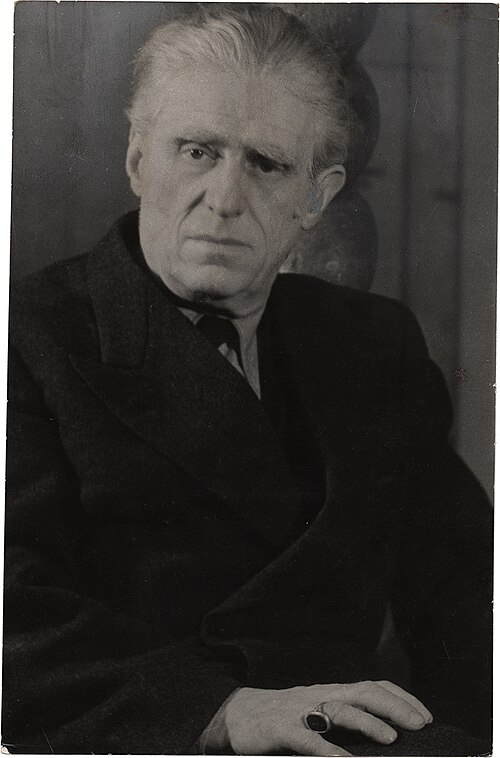
 Gian Francesco Malipiero (March 18, 1882 – August 1, 1973) was a prominent Italian composer, musicologist, music teacher, and editor who stood as a
crucial figure in the 20th-century Italian musical avant-garde.
Gian Francesco Malipiero (March 18, 1882 – August 1, 1973) was a prominent Italian composer, musicologist, music teacher, and editor who stood as a
crucial figure in the 20th-century Italian musical avant-garde.Queer Places:
Casa Malipiero, Via Foresto Vecchio, 8, 31011 Asolo TV, Italy
Gian Francesco Malipiero (March 18, 1882 – August 1, 1973) was a prominent Italian composer, musicologist, music teacher, and editor who stood as a
crucial figure in the 20th-century Italian musical avant-garde.
Born into an aristocratic Venetian family as the grandson of opera composer Francesco Malipiero, his early life was marred by parental separation in 1893. His father took him through Trieste, Berlin, and Vienna, but after a bitter split with his father in 1899, Malipiero returned to Venice to live with his mother and enroll at the Venice Liceo Musicale (now the Conservatorio di Musica Benedetto Marcello).
His musical development was unconventional and deeply self-directed. After stopping counterpoint lessons with Marco Enrico Bossi, Malipiero began copying scores by Claudio Monteverdi and Girolamo Frescobaldi at Venice's Biblioteca Marciana, instilling a lifelong devotion to early Italian music. He briefly rejoined Bossi for studies at the Liceo Musicale in Bologna, completed his formal studies back in Venice in 1906, and served as an assistant to the blind composer Antonio Smareglia. Between 1906 and 1909, he frequented Berlin to attend classes with Max Bruch.
A pivotal turning point occurred in Paris in 1913, where Malipiero associated with Maurice Ravel, Claude Debussy, Manuel de Falla, Arnold Schoenberg, and Alban Berg. Attending the historic premiere of Igor Stravinsky's Le Sacre du Printemps alongside Alfredo Casella and Gabriele D'Annunzio awakened him from what he called a long lethargy, prompting him to disown almost all of his previous compositions except for Impressioni dal vero (1910–11). Around this time, he gained sudden notoriety by entering five works under five distinct pseudonyms into a competition at Rome's Accademia Nazionale di Santa Cecilia, capturing four out of the five available prizes.
World War I forced him to flee Venice following the Italian defeat at Caporetto in 1917, after which he settled in Rome. During this era, his network crossed into the vibrant modernist art scene. Moving with Alfredo Casella and Filippo Tommaso Marinetti to Capri, the group mingled within artistic circles that harbored strong LGBTQ links, a frequent haven for bohemian and queer modernist figures of the era. In 1923, Malipiero joined Casella and D'Annunzio in founding the Corporazione delle Nuove Musiche to promote contemporary music. That same year, he permanently established his residence in the quiet town of Asolo.
Though initially on friendly terms with Benito Mussolini, Malipiero fell out of favor with fascist authorities when he set Luigi Pirandello's libretto La favola del figlio cambiato, which earned direct political condemnation. Even dedicating his subsequent opera Giulio Cesare to Mussolini failed to restore his standing. Professionally, Malipiero held the chair of composition at the Parma Conservatory from 1921 to 1924, joined the Venice Liceo Musicale in 1932, and served as its director from 1939 until 1952, mentoring influential figures such as Luigi Nono and his nephew Riccardo Malipiero. Alongside his original works, Malipiero achieved immense scholarly renown for editing the monumental complete edition of Claudio Monteverdi's oeuvre between 1926 and 1942, and later overseeing the publication of Antonio Vivaldi's concertos at the Istituto Italiano Antonio Vivaldi.
Stylistically, Malipiero held an anti-Germanic view of classical composition, rejecting post-Beethovenian sonata form and thematic development, which he found repetitive and artificial. Instead, he favored non-thematic, motivic, and free-form structures rooted in diatonism, Gregorian chant, and early Italian idioms. He termed his orchestral compositions "sinfonias" to distinguish his fluid, narrative approach from Austro-German symphonic tradition. His mature output includes seventeen symphonies, key stage works like L'Orfeide (1918–22) and La Passione (1935), chamber pieces such as Rispetti e Strambotti (1920), and orchestral suites like Pause del Silenzio (1917). In his final decades, his style evolved into tense, chromatic territories influenced by his modern pupils, until his death in Treviso on August 1, 1973. His legacy endures through recordings of his complete symphonies, revivals of his piano works, and Georg Brintrup's 1985 biographical film Poems of Asolo.
References:
 Capri: Island of Pleasure Hardcover – January 1, 1987 by James Money |
Other references:
Support this project
This website is a passion project researched, developed, and funded entirely by me. If you find the content valuable and would like to help support the ongoing research and hosting costs, any contribution is deeply appreciated.
Thank you for keeping this independent resource alive!
My books on Amazon: Elisa Rolle's books